
A vulnerable share: my journey with perimenopause
Coach Kerrie here! As we breathe life into the blog, I figured I might as well take a stroll down Vulnerable Lane and share my current health journey.
I want to preface this by saying that perimenopause looks wildly different for every woman. Truly, no two journeys are alike, which is both validating and incredibly annoying when you’re just looking for answers. Our timelines, and symptoms vary greatly. Not every woman who goes through pregnancy experiences severe postpartum symptoms—some are luckier than others—and perimenopause and menopause can be the same way.
To understand where I am now, it’s important to start closer to the beginning. When I was in my mother’s womb—OK, OK, not that far back.
My hormone journey really began around age 37, when I decided to come off hormonal birth control after nearly two decades. Something inside me just felt like it was time, and the book The Period Repair Manual (a strong recommendation for anyone with teenage girls!) pushed me to finally make that choice.
At the time, I worked with a nutritionist to help my body rebound from decades on birth control. We focused primarily on food and targeted supplements—two of which made the biggest impact: DIM and Vitex. I’m not a doctor, but these natural supplements made a huge difference for me and I still use them till this day.
Around that same time, I also made a conscious decision to set down a lot of judgment around my body—its composition, or lack thereof. I had healed my relationship with food years earlier, but I was still chasing the “last five pounds,” stressing over bathing suits before trips, and letting the scale dictate my mental state.
So I stopped weighing myself. I stopped tracking intake, started eating intuitively, and threw out every metric tied to my past “fittest” self. It felt incredibly liberating and remains one of the best decisions I’ve ever made.
I reclaimed the mental space the weight conversation had occupied for as long as I could remember. Contrary to my fears, I didn’t lose control without the scale keeping me “in check”, turns out it wasn’t the only thing holding my life together. I’d only weigh in at the doctor’s once a year, and for seven years I maintained a 2-4 lb swing in weight using that approach.
A year after my mom passed (I was 43), things began to shift again—quietly at first. I’d always carried some weight in my lower belly, but suddenly it crept into my upper abs. Annoying, yes, but not devastating. I’d done enough internal work to not spiral over a little fluff.
What concerned me far more were the mental symptoms.
It started with brain fog, lack of focus, trouble finding words, and difficulty finishing sentences (at one point I was Googling signs of dementia). At my yearly physical, I spoke with my doctor—someone I genuinely like and feel heard by—and she decided to run labs. She also mentioned the possibility of ADHD and suggested testing. At that time, perimenopause wasn’t even on my radar. The labs came back “normal,” so she referred me to a neurologist for ADHD testing.
But something in me kept canceling that appointment, which, in hindsight, might sound like ADHD… but also felt like intuition. I absolutely believe prescription medication has its place, but deep down I knew ADHD meds weren’t the answer for me at that point.
I saw an influencer pushing a code for a functional online company, and I decided to run labs through them. The consult was far more comprehensive than anything I’d experienced in conventional medicine, which I appreciated. Still, it felt impersonal. There were few questions about my cycle, personal history, or how I actually felt day to day. It was very black-and-white: this is what your labs show, and here’s what we recommend.
That experience planted an important seed—and it’s why I believe so deeply that the practitioner and the plan matters more than anything (something I’ll come back to).
Based on my labs, the recommendation was hormone replacement therapy—specifically testosterone—along with a GLP-1.
I was a hard no.
I didn’t want something I’d have to administer for life or grow (more) hairs on my chin, and at the time I viewed GLP-1s as a starvation tool. Ultimately, I didn’t feel educated enough to be comfortable with that decision. Instead, we tried a more “natural” route: food changes, DHEA, and other supplements meant to support testosterone production.
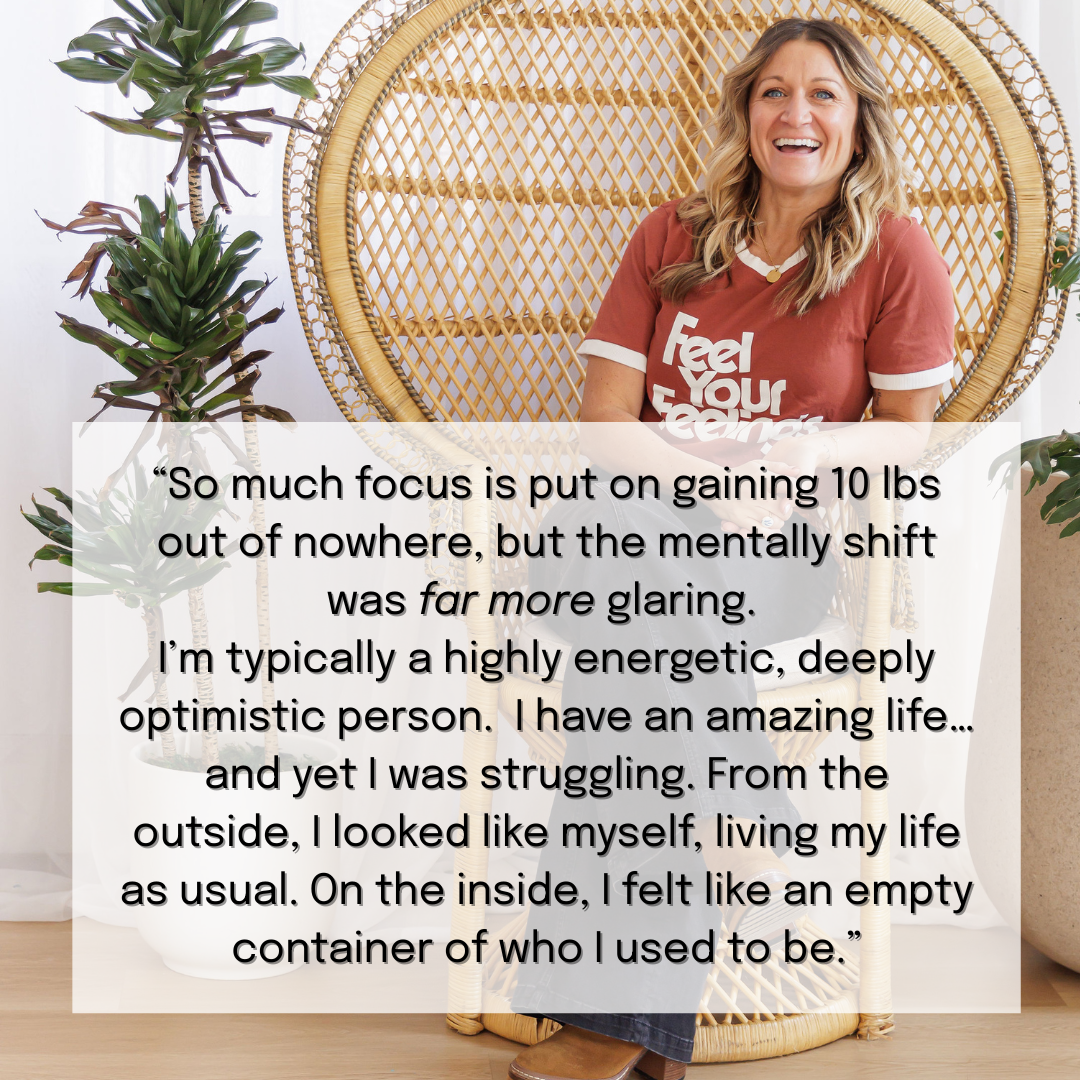
As time went on, things didn’t improve—they worsened. So much focus us put on gaining 10 lbs out of nowhere and meno-belly, and while that was true, the mentally shift was far more glaring. Beyond the cognitive decline, a low-grade depression settled in.
I’m typically a highly energetic, deeply optimistic person, the kind who can cry over a ladybug because life feels so beautiful. I have an amazing life…and yet I was struggling. From the outside, I looked like myself, living my life as usual. On the inside, I felt like an empty container of who I used to be. I’ve navigated real hardship—losing both parents, a business going under, deep grief—and this was different.
It wasn’t constant. There were moments when I felt like myself, but those windows grew shorter and shorter until it felt like I had only a few “good” days in an entire cycle.
During the harder stretches, getting out of bed felt heavy—not from exhaustion, but from a lack of motivation. My normal “joy” routines just felt flat. Nights were the worst. As soon as I lay my head down, intrusive thoughts crept in, replaying conversations, fears, and scenarios that didn’t make logical sense. They felt foreign, completely misaligned with who I am and how I see the world. I didn’t feel in control of my own mind, and that loss of internal safety was deeply unsettling. And then there was the rage. IYKYK.
Fast forward a year, and thank the high heavens (and the Instagram algorithm), Danielle messaged me. Danielle is a Nurse Practitioner I did CrossFit with years ago. She had stepped away from traditional medicine to open her own practice, Sparq Health, focused on longevity and menopause care—and was interested in collaborating. I was immediately intrigued.
We set up a time to meet, and from our very first conversation, I felt it—hair standing up on my arms. She was a wealth of information, but more importantly, she was speaking directly to what I was experiencing. I knew she was the missing piece I personally needed. I booked a consult on the spot.
After running labs with her and completing our initial consult, I gained more insight than I ever had from any medical provider before. We started simply—just three or four supplements, not a million—and within a couple of weeks, I felt a noticeable shift.
We talked about HRT—the current research, benefits, and misinformation. Even so, I went back and forth internally. Why would my body need support? Perimenopause is a natural process; shouldn’t I just let it run its course?
But then I started asking different questions.
We don’t hesitate to put teenagers on synthetic birth control. We don’t think twice about prescribing ADHD medication or SSRIs to women in their 40s. Yet we deeply wrestle with the idea of microdosing something the body already makes.
My mind kept going back to postpartum.
Postpartum is also “natural.” And yet when a woman is so unwell that she’s thinking about harming herself or her baby, we don’t tell her to let nature take its course. We support her. We help her survive that season and find her way back to herself.
That internal conflict lasted a while. It felt contradictory to how I live—holistic and intentional. But eventually, I landed here: I was willing to do whatever it took to feel like myself again. Not to bypass the process. But to be supported through it. Eventually, I decided to move forward with hormone replacement therapy.
For me, HRT gave me me back, almost immediately. Did it fix everything? No. I can still get a little ragey. It also took time to get the dosing right and I did experince bloating in the beginning. But mentally—holy cow. Energy returned. Joy returned. Emotional stability returned. Sex drive returned (bonus).
I still wrestle with the idea of being on HRT “for life.” I don’t know if this is forever or simply something I’ll use through perimenopause and menopause. For now, I see it as supplying my body with what it needs.
After a good period on HRT—and feeling good mentally—one thing that continued to shift was inflammation and body fat.
I have a solid health routine I genuinely enjoy: lifting, sauna 4–5x/week, red light therapy, meditation, inner work. I wasn’t ashamed of my body. I still lived my life, wore the bathing suit, and didn’t let it consume my headspace. But it was frustrating—doing everything “right,” feeling good mentally, and watching the needle move in the wrong direction.
I began tracking food again, ensuring I was eating enough calories, and focused on metabolic health. I tested for celiac, ran a GI map, and worked through gut protocols (periods of removing alcohol, gluten, and dairy). Still, the inflammation persisted. I went from maintaining my weight within a 2–4 lb range for seven years to gaining 14 pounds in eight months.
After many conversations with Danielle—and working through my fears—we decided to microdose a GLP-1.
With the GLP-1, I followed a microdosing protocol—just once a week at about a quarter of the normal dose. And honestly, the impact was almost immediate. Within the first two weeks, I noticed a reduction in inflammation throughout my body. I had developed puffy eyes that made me look tired no matter how much I slept. I looked less swollen and more like myself again. The most striking moment for me was during a yoga class: I’d been dealing with bursitis in my knee for over six months and couldn’t kneel on it. That day, I realized I could kneel on it for the first time in 6 months.
Throughout the process, I tracked my body composition using my InBody scan to make sure I was maintaining muscle, that was non-negotiable for me. In the beginning, most of what I lost was water and inflammation — not body fat. And I can absolutely see how that initial drop could get someone excited and chasing the number on the scale. The scale moves quickly, you feel lighter, and it’s easy to assume it’s all fat loss. But it’s not.
That’s exactly why using the scan was so important for me. It wasn’t about obsessing over data. It was so I didn’t get distracted by short-term shifts and lose sight of long-term health. It allowed me to see what was actually happening inside my body, not just the total number, but muscle mass, body fat, and fluid shifts. It kept me grounded on the real goal: maintaining muscle through diet and strength training while allowing fat loss to happen gradually. It took about three weeks before I started seeing true fat loss reflected on the scan.
At this point in my life, the part of me that gives zero shits about how people think I look in a bathing suit largely outweighs the part of me that was completely consumed by it. This wasn’t about external validation for me. I didn’t experience shame around the weight I gained during perimenopause, but at the same time, admitting I wanted to feel and look my best—even after doing “the work”—felt complicated.
There was also this other discomfort; a shame around using these tools.
As someone who works in the wellness space, I felt caught between three very loud camps. There’s the camp that’s firmly against these tools, the camp that’s aggressively for them, and the camp that exploits them— overprescribing and marketing them as magic bullets. None of those spaces felt fully aligned.
What felt hardest was stepping out of my role as an “expert” and into the role of a user. And that came with a quiet fear of being seen as hypocritical, naïve, or “shouldn’t you know better?”
The wellness world can be brutal in that way. We preach body autonomy and informed choice, but we also love a clean narrative. You’re either fully natural or fully medical. You’re either disciplined or taking shortcuts. You’re either empowered, or you’ve somehow failed.
Real life, of course, lives in the gray.
That’s exactly why I’m sharing this now. I refuse to gatekeep information—or my own experience—because of shame or fear of how it might be interpreted. I also want to normalize anyone else who feels conflicted for making choices that are right for their body and their life, even when those choices don’t fit neatly into a single camp.
Sometimes the most honest thing we can do is step out of ideology and into lived experience, and allow ourselves to be human there.
I also want to be clear about this: I deeply value the perspective and privilege that comes with aging, I don’t want to bypass it. What I do want is to feel like the Kerrie I enjoy being—the one who has the capacity to stay present, to feel deeply, and to soak up this hard but beautiful life. For me it’s about preserving that connection as I move forward into the next chapter.
All of this to say: I still have days when I struggle. HRT/peptides haven’t magically solved everything; decision fatigue and the desire to sell all my belongings and move to Thailand still exists.
Let’s chat some pros (and honest cons) from my experience:
Pros
• HRT help me add muscle, improve my sleep, energy, libido and performance in the gym.
• HRT significantly improved my joy and sense of “self”. The improvement in my mental state is the biggest win for me.
• Low dosing GLP-1 has helped reduce inflammation significantly and improve my body compostion without crushing my appetite.
• I felt reduced “food noise” but also overall brain chatter, less compulsive consumption (gum, drinks) and almost zero desire for alcohol (also a win).
More importantly…Cons/Unknowns
• HRT took time to find my dosing, and caused bloating initially.
• I’m still unsure about long-term commitment to HRT.
• Testosterone is not approved for females.
• Glp made diminished joy around food—and as a foodie, that’s been hard for me.
• Because of this it made me super conscious of fueling myself, and I had to get crafty to get in calories I enjoyed. I can see this being a huge obstacle for some and why they go with not eating at all. I think this alone is why people will either maintain results or rebound.
• While I truly believe the increased awareness around fueling is required, I look forward to returning to an intuitive approach after this process.
• With a history of disordered eating, I can also see this being a very slippery slope. I wouldn’t doubt if we see an increase of adult eating disorders and metobolic dysfunction.
• My performance took a hit on the GLP. While I have been able to maintain my strength, I don’t have the “push” I had on HRT alone.
• Energy dipped initially, I was sleepy AF the first few weeks of micro-dosing. Hydration and electrolytes helped here (and are a must IMO).
• Hair shedding is real. This is also a peri symptom, so I am unsure if it started prior or after treatment. Praise be I have a shit-ton of it.
• The hippie-dippy holistic part of me still struggles with being on hormones + peptides.
• Low-dose GLP’s are not well-researched for perimenopause specifically.
• Cost — This is not inexpensive. Between labs, practitioner support, cost of meds, the financial investment adds up quickly. Sadly, access and affordability are real barriers, and this isn’t a casual commitment.
Most importantly—the practitioner and the plan matters.
Access to HRT and peptides is everywhere. Cheap online scripts or aesthetic providers focused solely on weight loss—with no understanding of long-term health—are not it. What I see far too often (within my own community) is people being overdosed, crushing their appetite, and rebounding hard when they come off. You will 100% get results on a GLP-1, and many women feel that progress will be enough to motivate them to stay “on track” after. I’ve already seen so many women go on>off>and back on it, like it’s the new weight watchers. It doesn’t need to be that way.
For me, being committed to true health during this process, means lifestyle upgrades, body composition tracking, and a long-term view of who you want to be 20 years from now.
Lastly, I don’t share this because I think everyone should follow the same path. I share it because the conversation around perimenopause is often oversimplified: “lift three days a week, get your steps in, eat your protein, and you’ll cruise through it.”
For some women, that might be true. For others, doing all of the “right” things isn’t enough, and that can feel isolating. Our experiences are different, and sometimes taking care of yourself means making choices that feel right for you—period.
If you are struggling or have questions about anything, please free to email me info@kfitbody.com, I am happy to be a resource and share more of my own journey as you navigate yours.
